About the author
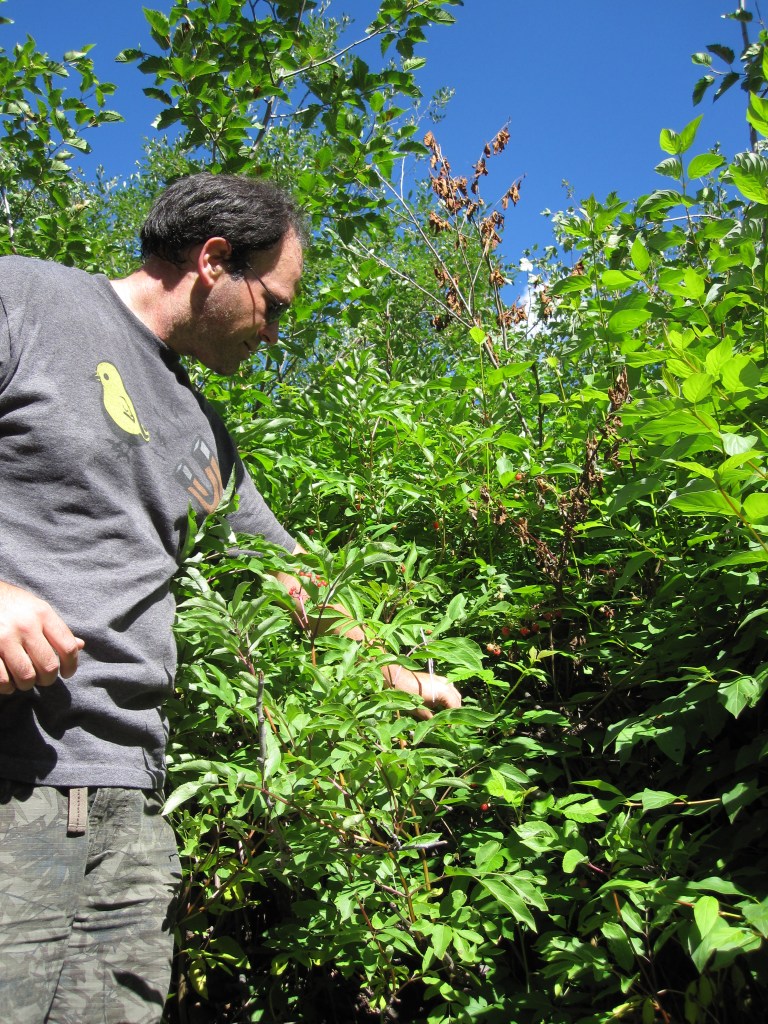
I found quite a lot of raspberries on this hike. No, I’m not telling you where. I also added this picture since I miss that chick magnet shirt.
New here? Think (or better yet click) here to get to our main page.
BaitCoinflIp by Brendan ZaChary AllIson
He pulled her into room 19, slammed the door to his luxury suite, then stumbled as he turned toward her. “Time for a celebration! So… my bedroom’s over here,” he slurred while pointing sloppily with one hand and groping her left breast with the other. He missed both at first.
She glared, slowly moved his hand off her little black dress and its large tan contents, then protruded her lower lip poutily. “But Professor Falken,” she whined, “You said you’d try my brain interface first.”
“I… don’t remember that first part.”
“Oh. And you said you liked me for my mind.” She shrugged. “Well, it’s kinda late, maybe I’ll just go-”
“No no no wait Jennifer it’s really titillating we can try your brain thing now. Uh. What do I do?”
“Just sit at your computer desk there. I’ll put in this USB stick… there… and need a minute to put this cap on your head.” It took her about 20 seconds.
“Now what?”
“I told you at the cocktail lounge. I need data from different people looking at images for this class project. So just sit here for about 2 minutes and look at the monitor.” He complied grudgingly.
Three minutes later, she was in the adjacent hotel room with a much soberer man. “See, Henry? Case study proving professors are dumb.” She grinned. “These are the images that he uses to access his account. That’s all you need, right?”
“Yeah,” Henry replied while she put the cap on him. “MindBase passwords require paying attention to one out of 20 images four times. I also need to match his visual evoked potentials within a certain tolerance. Working on the EEG authentication now.”
“Right, you’re supposed to be the best at that, Professor. Otherwise I wouldn’t need you.”
“And I thought you liked me for my mind. Now I need to concentrate while doing it or my ERPs get too small. ” He took a deep breath, then leaned back and watched the screen as 20 images flickered and oscillated in front of him, then three more sets of 20 images. “I’m in. Transferring 20 million in mindcoin to our shared account…. Done.” He pointed to the bedroom and winked. “Time for a celebrat-”
She pushed a button on the back of his cap and a poisoned needle poked into his medulla.
Author Commentary
Characters’ names are shout-outs to earlier narratives. “Professor Falken,” “David,” and “Jennifer” are all from Wargames, which was about hacking. Henry Case was the protagonist in Neuromancer, which entailed neurohacking.
MindCoin and MindBase are drawn from BitCoin and CoinBase. I amused myself killing science professors. In real life, I strongly oppose doing so, since I am one. The “flip” reflects that coins can be flipped and the fact that Jennifer “flips” both professors.
I did amuse myself with boob puns. The word “both” in the first paragraph could refer to the bedroom or right breast. That primes the reader for the word “titillation” later. I like being easily amused. Like the story says, science professors can be stupid. “Boob” puns here could refer to me being a boob.
Realism
This is one of many stories that aims to predict what’s going to happen in various ways. Neurosecurity is a growing field. My old friend Thorsten Zander is leading a huge project involving brain-based cybersecurity. Chile, California, and Colorado passed laws about neurosecurity and a lot more are being considered. So you’ll probably see more of this topic soon. It includes user authentication (identifying who you are) and account access (getting into your account), which are both addressed in this story. Another big element is keeping your data safe.
The approach used to identify images of interest is RSVP, or Rapid Serial Visual Presentation. One of my old friends and former labmates is quite familiar with it. This is not new at all. I wrote a story about that over a decade ago and there are many papers about it, such as this one. You can present images 10 times per second and identify which ones are most interesting, memorable, noteworthy, etc. This has also been commercialized; you can find a video about it from the manufacturer here.
You probably have a PIN code for your ATM card. It has a drawback – anyone can see you enter the numbers and thereby steal your pin. One solution would be to have PIN codes that rely on attention or some other cognitive activity without any movement. People can see which buttons you touch or where your eyes move. They can record voice-based passwords. But a BCI is a completely private way of transmitting information from the brain to another system. Of course, you can always intercept the information further downstream or somehow trick the user into revealing the password like this story. Other work of mine (which is also copyrighted) has an Attentional Personal Identification Number.
The approach described here relies on paying attention to visual stimuli that both oscillate and flash. This type of P300/SSVEP “hybrid BCI” approach was introduced in Allison, 2009 and mentioned again in Pfurtscheller et al. 2010. The oscillations would produce SSVEPs or other c-VEPs and the flashes would produce P300. Hence, you have a sort of two-factor authentication within a single display without any added burden to the user.
However, attention isn’t the only BCI-based mechanism for user authentication. You could also identify users based on unique patterns of alpha or ERD/ERS, for example. This idea isn’t at all new; look at this figure from two of my former bosses (Pfurtscheller and Neuper, 2006):
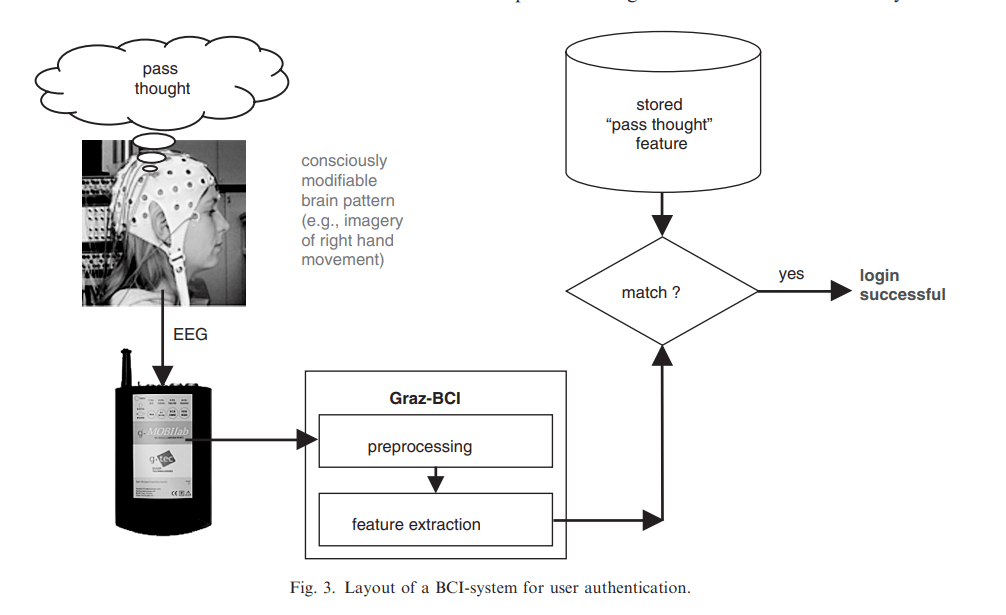
So, like many stories, this is not only technically possible today but could have been done decades ago. The main reason you don’t see these and other BCI-based technologies is that almost nobody has the necessary hardware. If more people had BCIs, you’d see a lot more applications with neurosecurity, communication, gaming, sleep medicine, monitoring all kinds of things, and much more. And with hardware costs plummeting soon (and I look forward to being able to say why), you’ll see a lot of these applications following the Gartner Hype Cycle.
Another realistic projection of current issues is people treating security as boring and mundane. If it were fun, it might be called fundane. We login to accounts all the time and prefer to do so with as little effort as possible – and this probably won’t change with neurosecurity.
Hope
This is pessimistic in obvious ways. Evil wins. Two professors die, although one was a (failed) thief and the other is up to interpretation. I never specified that Professor Falken died, but it’s a reasonable assumption.
Edit History
I wrote this in Feb 2025. The first draft was much shorter. I sent it to Andy Weir and an old friend who’s familiar with bitcoin. They said that the technology wasn’t clear, so I added more details about it. I also added some more dialog for humor and character development. I posted this version in Mar 2025.
 bcifi
bcifi 
Leave a Reply! BCI-based commenting is not yet enabled :)